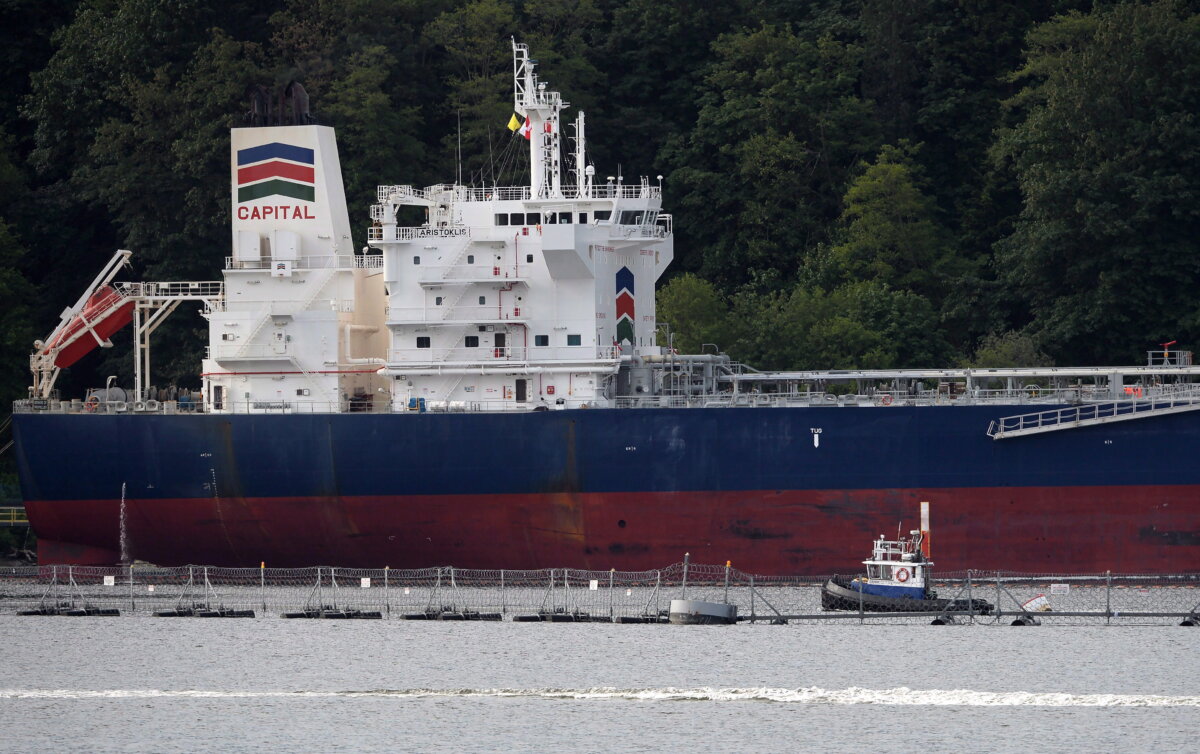

The Conservative Party is urging Prime Minister Mark Carney to repeal the oil tanker ban on British Columbia’s northern coast, arguing the restrictions are limiting Canada’s ability to sell oil to overseas markets.
In an Oct. 26 letter to Carney, Conservative Leader Pierre Poilievre and other opposition MPs called on the Liberal government to support Bill C-264, a private member’s bill that would repeal the Oil Tanker Moratorium Act and remove restrictions on certain oil tanker operations along the northern coast.
“We have a chance to diversify oil exports overseas to boost jobs, our dollar and our economic independence from the United States with no need for government subsidies, using mostly existing infrastructure, with shovels in the ground now and oil flowing in under two years,” the letter said.
The Conservatives cited a proposal by Calgary-based Strathcona Resources to ship up to 250,000 barrels of oil per day by rail to an export terminal in Prince Rupert, B.C., for shipment to Asian and other international markets. The proposal would require the tanker restrictions to be lifted or amended before large crude oil tankers could load the oil at a northern B.C. port.
The Oil Tanker Moratorium Act, passed in 2019 under the former Liberal government of Justin Trudeau, prohibits vessels carrying more than 12,500 metric tonnes of crude oil or persistent oil products from stopping, loading, or unloading at ports or marine installations within designated waters off northern B.C. The law exempts smaller shipments and certain non-persistent oil products.
The Conservatives argue the ban is limiting Canada’s ability to expand oil exports through Prince Rupert, while American tankers carrying Alaskan oil continue to operate along the Pacific coast under different rules.
The letter said the ban “effectively donates billions of dollars” to the United States by forcing Canada to sell oil at a discount, allowing American refineries to capture greater profits. The Conservatives argue that lifting the restrictions would give Canadian producers access to more international buyers and potentially higher prices.
The MPs said they were prepared to work with Liberal members on amendments to the bill if the government supported it at second reading on Oct. 28, with the aim of allowing the Prince Rupert proposal to proceed.
Carney had committed to maintaining the northern tanker ban in July, when Ottawa and British Columbia signed an infrastructure agreement. The agreement accompanied plans to advance a separate pipeline using a southern B.C. route that would not require changes to the moratorium.
The Liberal government has also previously signalled its opposition to Bill C-264 and opposed a blanket repeal of the moratorium. During House of Commons debate in May, Liberal MP Taleeb Noormohamed called Bill C-264 “a one-line proposition dressed up as serious policy.” He argued that the bill did not provide new evidence addressing the environmental risks of oil spills on the north coast and criticized the Conservatives for not consulting indigenous communities.
Liberal MP and Parliamentary Secretary to the Natural Resources Minister Claude Guay also argued in May that repealing the law would remove existing restrictions and environmental protections without a specific project proposal to assess. He said the government favoured considering possible changes in the context of a particular project, with its risks, economic opportunities, and mitigation measures examined.
The federal government and B.C. signed an infrastructure agreement in July that included a commitment to maintain the northern tanker ban “without alteration, suspension, or narrowing of scope.”
Then-premier David Eby, whose New Democratic Party lost the Oct. 24 provincial election, said the agreement would protect the northern coastline and the “$2 billion-plus economy that relies on it.” Eby had opposed a new Alberta-to-B.C. oil pipeline but accepted that the province had constitutional obligations related to its construction.
The agreement followed a separate proposal for the Pacific Link pipeline, which would transport oil from a receipt terminal in Bruderheim, Alta., northeast of Edmonton, to a deepwater export terminal in Delta, B.C. Ottawa has said it will designate the southern-route pipeline as a project of national interest to accelerate its development, while Alberta expects it to be completed no later than 2034.
Unlike the proposed Prince Rupert export project, the Pacific Link pipeline would use a southern route and would not require repeal of the northern tanker moratorium.
Alberta Premier Danielle Smith commented on the Tories’ Bill C-264 on Oct. 26, expressing her support while saying removing the ban “would open the door” to crude-by-rail exports through Prince Rupert and give her province another route to reach global markets.
“Canada cannot become a global energy superpower while federal policies continue to stand in the way of getting our energy to the world,” she said on X on Oct. 26. “Repealing the tanker ban is an important step toward securing better prices for our resources and building a stronger, more prosperous Canada.”
 Friends Read Free
Copy
Facebook
Tweet