Malaysian Prime Minister Anwar Ibrahim said on Nov. 13 that there was no indication so far that advanced artificial intelligence chips linked to Singapore-based Megaspeed had been exported from Malaysia, even as his government examined the movements of the equipment.
Anwar told reporters, “There has not been any indication of that,” according to Malaysia’s state-owned Bernama news agency. He said Malaysia had received no formal request for assistance from Singapore or the United States, but would cooperate with any investigation.
In a statement issued the same day, Malaysia’s Ministry of Investment, Trade and Industry (MITI) said it was working with customs officials to determine whether chips brought into the country by Megaspeed affiliate Speedmatrix Sdn Bhd had subsequently been shipped elsewhere.
Speedmatrix rents space in Malaysian data centers and brings in its own servers and AI chips, according to MITI. Importing those chips does not currently require a Malaysian permit or license.
Malaysia introduced restrictions on the export, transshipment, and transit of high-performance U.S.-origin AI chips in July 2025, with specific technical thresholds and licensing conditions.
The Epoch Times reported in June 2025 that Malaysian authorities were investigating reports of a Chinese company using Nvidia-equipped servers in the country to train AI models.
In its Nov. 13 statement, MITI said it had never cleared Megaspeed or Speedmatrix of potential wrongdoing. Previous government visits to facilities used by Speedmatrix were routine monitoring activities, not compliance approvals.
Malaysia is also preparing tighter oversight of its expanding data-center industry.
Trade Minister Johari Abdul Ghani said on Nov. 12 that the government intends to require operators to disclose information including the number of graphics processing units (GPUs)—chips used for demanding AI computations—their locations, facility operators, and electricity consumption.
Johari said 55 of Malaysia’s 117 approved data-center projects had begun operations. The proposed reporting requirements have not yet been enacted.
Southeast Asia’s AI Boom
The scrutiny comes as Southeast Asian countries attract billions of dollars to build data centers that house the powerful computers used for AI and cloud services.
Malaysia recorded 385.7 billion ringgit (about $94.7 billion) in data-center-related investment approvals from 2021 through the first half of 2026, according to the Malaysian Investment Development Authority.
Thailand approved 42 data-center projects between 2024 and 2026, representing 750 billion baht (about $22.6 billion) in planned investment. Ten were controlled by Chinese investors and five by U.S. investors, according to Thailand’s Board of Investment. The figures represent approvals, not necessarily completed facilities.
The expansion has drawn attention in Washington because Chinese technology companies can obtain advanced American AI computing power without necessarily importing restricted chips into China.
Instead, a Chinese customer can rent computing power from a data center overseas and access it over the internet. The chips remain in another country while the customer uses their processing capacity remotely.
An October analysis by the Washington-based Institute for Progress estimated that Chinese users could remotely access computing capacity equivalent to approximately 2.8 million Nvidia H100 chips by the end of 2027. About three-quarters of that projected overseas capacity would be concentrated in Southeast Asia.
U.S. export controls already restrict certain advanced chips supplied to Chinese-headquartered companies, including their overseas subsidiaries.
The Commerce Department’s Bureau of Industry and Security clarified in May that those licensing requirements remain in effect.
Remote access through cloud services presents a different challenge because the chips themselves may never leave an overseas facility.
Congress has sought to address that gap. The Remote Access Security Act, which passed the House 369–22 in January, would expand U.S. export-control authority to cover remote access to restricted technology. The bill remains pending in the Senate.
Sen. Michael Bennet (D-Colo.) asked senior administration officials on Nov. 11 for information about Megaspeed, possible export-control violations, and U.S. coordination with Southeast Asian governments. He requested responses by Nov. 24.
Megaspeed Under Investigation
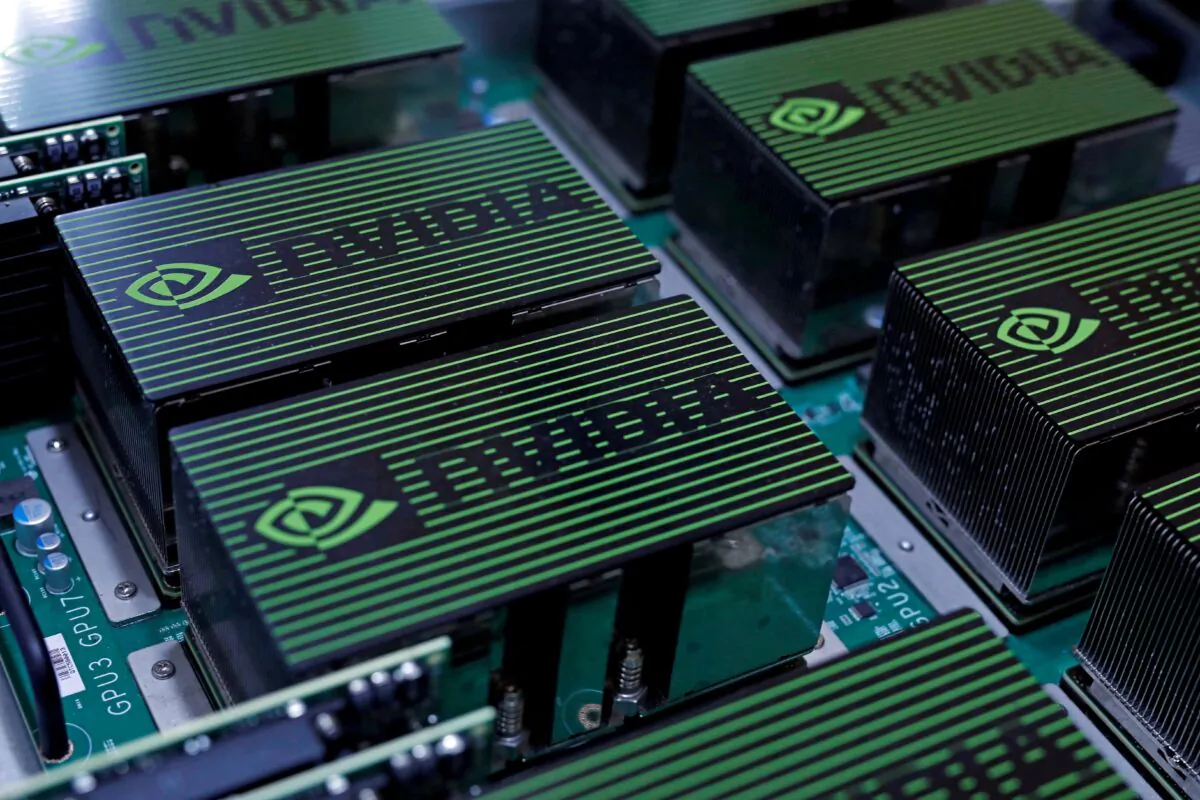
Megaspeed advertises cloud-computing services using advanced Nvidia processors, including H100 and GB200 systems, on its company website.
The company has also drawn scrutiny because of its former chief executive Huang Le, also known as Alice Huang.
Singapore’s Ministry of Home Affairs said on Nov. 12 that Huang was Megaspeed’s chief executive, chairperson and one of its key controllers when police began investigating suspected false declarations related to server purchases in February 2025.
Singapore police sought to determine whether servers shipped through Singapore to Malaysia were subsequently sent elsewhere, contrary to declarations made to suppliers.
The ministry said investigators found insufficient evidence to establish Huang’s involvement in the suspected declaration offenses. She was not investigated for espionage.
According to the Ministry of Home Affairs, “Huang had provided information which she knew to be inaccurate to [Singapore Police Force] in the course of investigations, to downplay her role in Megaspeed. She was issued a stern warning and barred from re-entering the country.”
Investigations into Megaspeed remain underway, the ministry said.
Megaspeed said in a statement on Nov. 12 that it had cooperated with U.S. inspections and retained an American law firm to conduct a comprehensive inventory of its GPUs and independently review its compliance with export controls.
 Friends Read Free
Copy
Facebook
Tweet