
Conservative Party Leader Pierre Poilievre is accusing the federal government of masking the actual number of people it plans to grant permanent residency to.
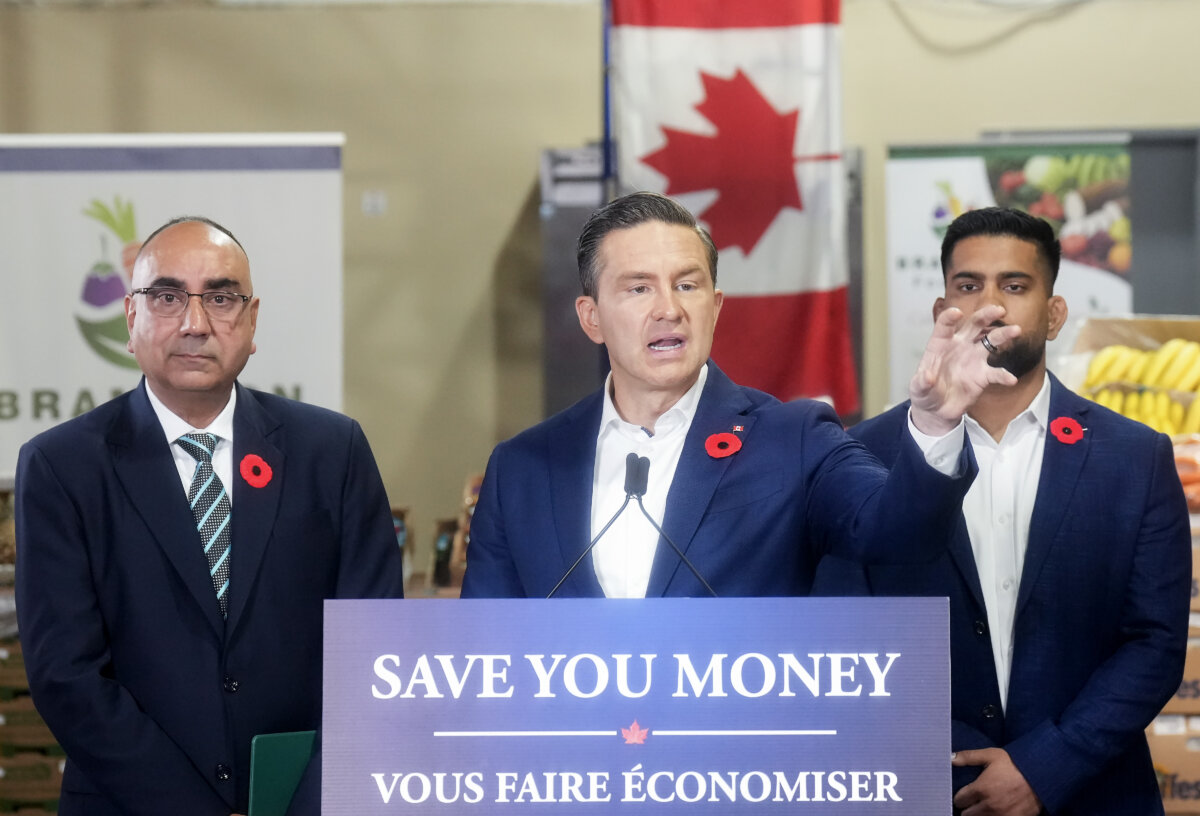
Speaking to reporters in Brampton, Ont., on Nov. 6, Poilievre alleged that Prime Minister Mark Carney had “cooked the immigration books” and concealed the government’s immigration plans in the 2026 budget released on Nov. 5.
Poilievre said that while the government had announced plans to stabilize permanent resident admissions at 380,000 annually, it also intended to fast-track permanent residency for another 200,000 temporary residents already living in Canada by the end of 2027.
The Tory leader said that the additional admissions would bring the total number of new permanent residents to 650,000, “by far a record and much bigger than any of the years” under former Prime Minister Justin Trudeau.
“We love immigration for people in numbers that we can absorb, where there are jobs, health care, and housing, but not when the numbers exceed our capacity to absorb people,” Poilievre said.
Meanwhile, Carney said in Winnipeg on Nov. 6 that the one-time permanent residency measures are intended to formalize the status of people who have already lived and worked in Canada for years.
He said many of those expected to receive permanent residency are workers whose employers must apply annually to renew their permits.
“They are members of the community, as I say, and they are in many respects—in all respect—permanent residents of the country and we’re formalizing it,” Carney said.
Budget 2026 maintains the previous year’s targets of 380,000 permanent resident admissions and 370,000 new temporary resident arrivals annually for 2027, 2028, and 2029.
The budget also proposes a one-time initiative to grant permanent residency to up to 200,000 people already in Canada by the end of 2027, with additional admissions space provided for certain immigration pathways.
Of those 200,000 people, up to 100,000 would be workers eligible under the federal Express Entry system or provincial nominee programs, which allow provinces to select immigrants based on their economic needs. The remaining places would support humanitarian immigration pathways and help address application backlogs.
The initiative follows measures announced in Budget 2025 to fast-track permanent residency for approximately 115,000 protected persons and up to 33,000 temporary foreign workers by the end of 2027.
Protected persons are individuals recognized as needing protection in Canada, including successful asylum claimants. The earlier measures were also described as one-time initiatives, with protected-person admissions occurring outside regular permanent resident targets.
Employment Concerns
Poilievre said the budget’s immigration plans were unfair to newcomers and Canadians already living here, particularly amid job losses and high youth unemployment.
He said Canada has lost more than 130,000 jobs over the previous three months and argued that higher immigration levels would make it more difficult for people to find work.
The Conservative leader also reiterated his position that the Temporary Foreign Worker Program should be eliminated in communities where unemployment exceeds 5.5 percent, adding that “Canadian jobs should go to Canadians first.”
Meanwhile, Ottawa has proposed spending $151.5 million over five years to reform the program, speed up processing, strengthen employer compliance, and better align recruitment with regional labour market needs.
The government has not announced the specific reforms but says it will consult with provinces and territories before implementing changes.
Budget 2026 also proposes $302.3 million over four years, beginning in 2027–2028, to support the one-time permanent residency initiative, followed by $90.6 million in subsequent years.
The Canadian Press contributed to this report.
 Friends Read Free
Copy
Facebook
Tweet