




The federal government is slated to invest millions to develop treatment with ibogaine, a psychedelic drug, Health Secretary Robert F. Kennedy Jr. said on Nov. 12.
The Advanced Research Projects Agency for Health, part of Kennedy’s agency, is investing up to $4.9 million to lay the groundwork for regulatory and manufacturing needs for future ibogaine clinical trials, rather than directly funding trials.
Ibogaine is illegal in the United States, but President Donald Trump signed an executive order in April that directed agencies to open up access to it and some other drugs for people with mental illnesses. Ibogaine has been tested in other countries, including Mexico, where it is not prohibited.
Mark Cuban Cost Plus Drug Company will work on laying the foundation for a domestically manufactured, single-molecule ibogaine product for future trials exploring whether ibogaine can treat post-traumatic stress disorder and other mental illnesses, officials said. Another company, Beond Inc., which has treated patients with ibogaine in Mexico, will provide the government with data, Kennedy told reporters during a briefing in Washington.
“That is going to allow us to dramatically accelerate the clinical trial process,” Kennedy said. “So we’re going to have, I think, a record drug approval process.”
Kennedy also said that the government will be funding a separate effort to investigate whether ibogaine can treat addiction. That funding will be announced before the end of the year, he said.
Dr. Al Bugazia, senior adviser for special projects at the Advanced Research Projects Agency for Health, said veterans and millions of other Americans suffering from serious mental illness deserve the best possible care.
“Reports of successful ibogaine treatments are too promising to ignore. We owe it to our heroes and every person struggling to ask the bold questions and deliver results in years, not decades. As long as people continue to struggle, doing anything less is not an option,” he said.
The initial funding commitments span five years and will not be renewed unless certain milestones are reached, officials said.
“Researchers must establish whether ibogaine can help patients, identify who might benefit, determine whether those benefits justify the risks,” Kennedy said. “They must also investigate how long any improvement lasts. We will judge this work by the quality of the evidence.”
Doug Collins, secretary of Veterans Affairs, appeared with Kennedy and said that it’s important to develop the best science that can be produced in the effort to develop new treatments for post-traumatic stress disorder.
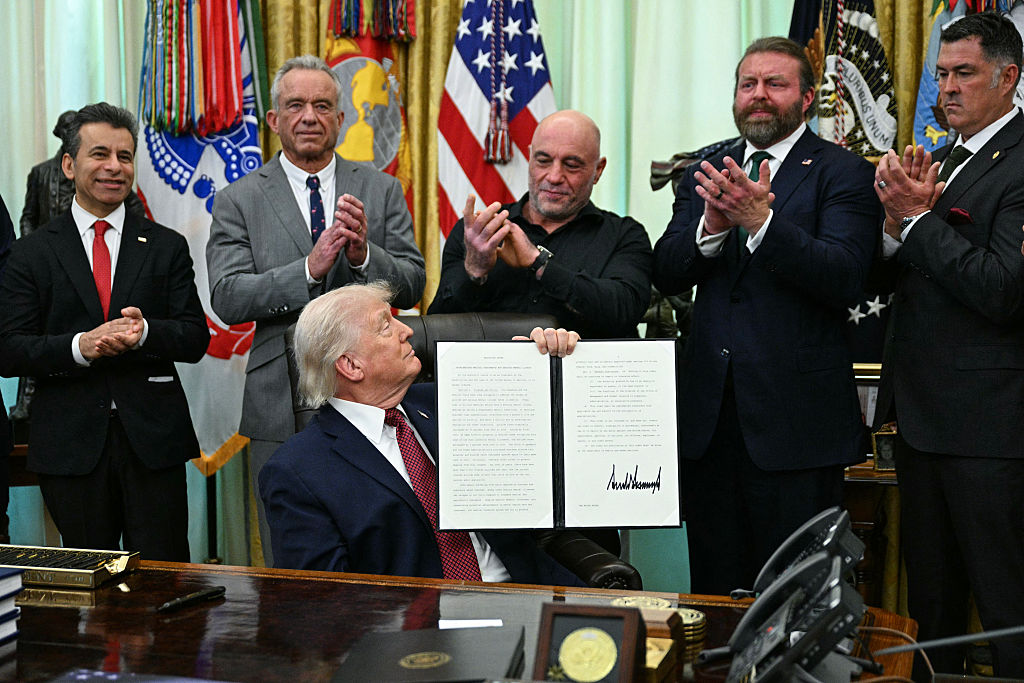 (L–R) FDA Commissioner Marty Makary; Health and Human Services Secretary Robert F. Kennedy Jr.; podcaster Joe Rogan; W. Bryan Hubbard, CEO of Americans for Ibogaine; and former Navy SEAL Marcus Luttrell applaud after President Donald Trump signed an executive order in the White House on April 18, 2026. (Jim Watson/AFP via Getty Images)
“Patients facing serious conditions that have not responded to existing treatments deserve rigorous scientific investigation of promising new approaches,” Dr. Michael Davis, director of the FDA Center for Drug Evaluation and Research, said at the time.
“With ibogaine, there are important scientific questions as well as serious safety concerns. We are seeking high-quality data and input that can help inform clinical research while putting patient safety first.”
The National Institute of Mental Health also announced on Thursday that it will provide up to $20 million in funding to support research into rapid-acting psychotropic drugs such as ketamine and psilocybin.
Some of the money will likely go to establishing a center to coordinate data collected across studies on the drugs, Andrea Beckel-Mitchener, acting director of the institute, said at the briefing.