



The United States measles elimination status has been withdrawn amid ongoing outbreaks, the Pan American Health Organization (PAHO), part of the World Health Organization, said on Nov. 17.
The organization’s Measles and Rubella Elimination Regional Monitoring and Re‑Verification Commission recommended withdrawing the status for Bolivia, Mexico, and the United States, and Dr. Jarbas Barbosa, director of PAHO, accepted the recommendation, officials said during a briefing.
“While this is a significant setback, countries are already taking action to bring their outbreaks under control,” including improving vaccination rates, Barbosa told reporters.
The U.S. Centers for Disease Control and Prevention (CDC) did not respond to a request for comment by the time of publication.
The CDC’s director said during a Nov. 12 event that the agency is working to vaccinate people and to convey the seriousness of measles—and how to isolate when infected—to those who decline vaccination.
PAHO defines elimination of measles as not having a measles virus transmission chain of the same genotype and lineage continuing uninterrupted for at least 12 months.
The status for the United States has been in place since 2000. Since then, measles cases have occurred each year in the country.
Some other countries, such as Canada, previously lost their measles elimination status.
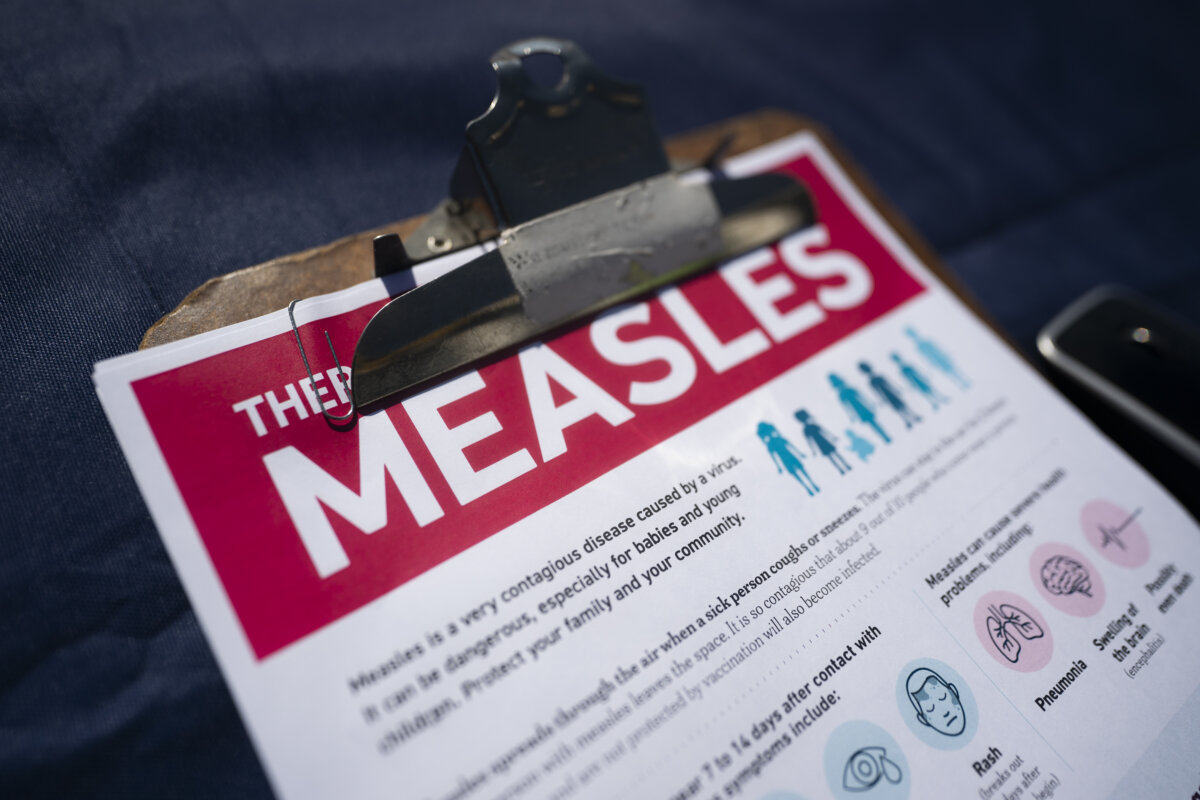
Measles is a contagious disease that primarily affects children. It spreads through contact with droplets emitted by infected people. Symptoms include rash and fever.
Most people recover in a few weeks, but a small percentage suffer severe complications and a subset of those die.
The United States has recorded more than 5,400 cases of measles this year, the highest annual total since 1991, according to the CDC.
There have been 43 outbreaks reported in the country, including in Pennsylvania and Wisconsin, and the vast majority of the cases have been linked to outbreaks.
Researchers with the CDC and other institutions reported in a paper this week that during outbreaks from Jan. 1, 2025, to Sept. 28, 2026, there were 112 confirmed cases of measles among pregnant women and 13 cases of congenital measles among infants.
Nearly all of the cases occurred among individuals who were unvaccinated or had unknown vaccination status, the researchers said, adding that measles vaccination coverage is important to prevent measles.
Measles vaccination is not generally recommended for pregnant women or children under the age of 1. Children from 6 to 11 months of age in outbreak areas can receive the shot, according to the CDC.
U.S. officials have promoted measles vaccination, but some—such as Health Secretary Robert F. Kennedy Jr.—have also emphasized that the vaccine can cause side effects, that vaccine protection declines over time, and that certain communities have declined to receive the shot.
The officials have said it’s important that doctors know how to treat measles to avoid unnecessary deaths.
Rep. Kim Schrier (D-Wash.), a pediatrician, was among those lamenting the loss of the status and blamed Kennedy.
The health secretary has refused to “just tell parents, go immunize your children to protect them from this terrible disease,” she said in a video.
Kennedy has endorsed the measles, mumps, rubella (MMR) vaccine as the best way to prevent measles.
Dr. Jane Orient, executive director for the Association of American Physicians and Surgeons, told The Epoch Times in an email that measles has never actually been eliminated and probably never will be.
“Vaccine immunity is not perfect, and it wanes,” Orient said. “Mother’s natural immunity used to protect babies. Considering vaccine adverse effects, its net effect may well have been harm, but given the lack of natural immunity, what are we to do?”