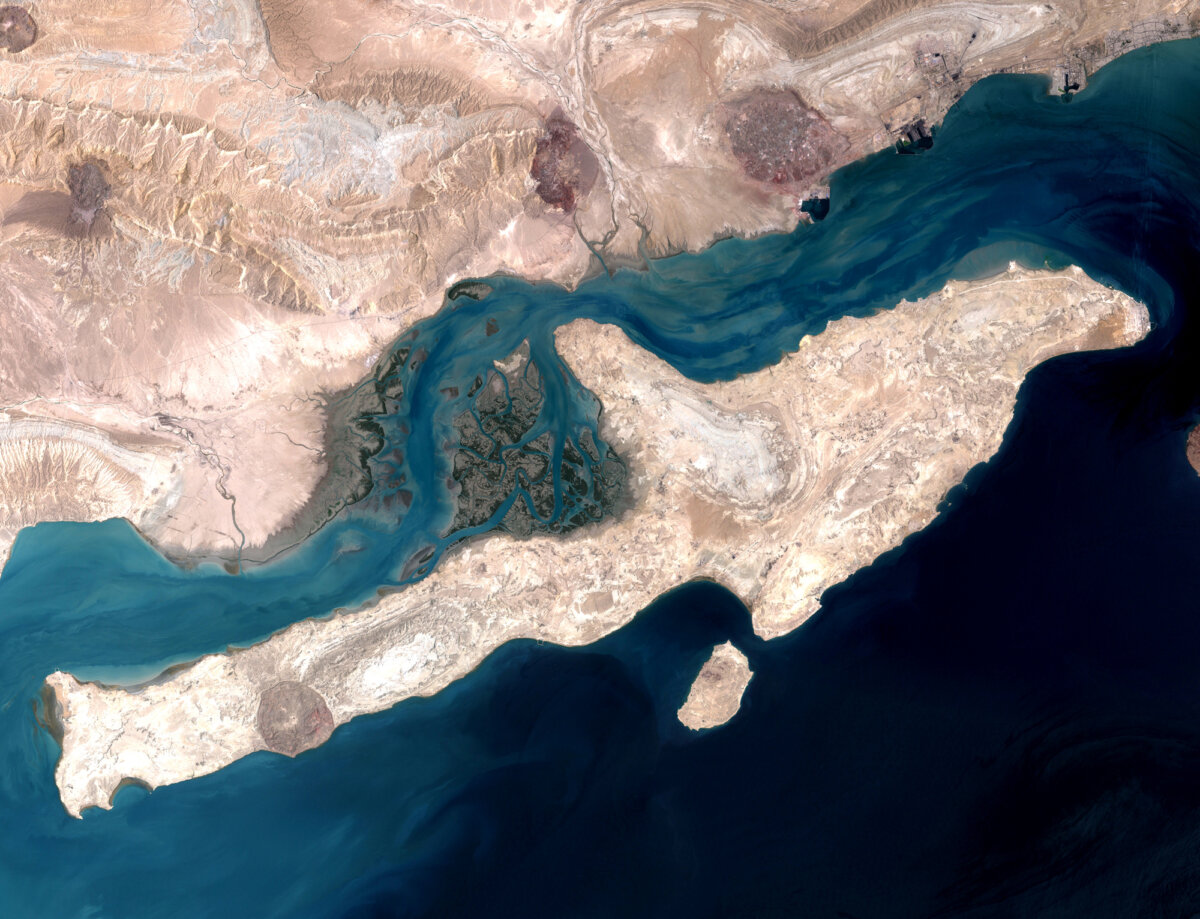

U.S. fighter aircraft struck targets on the Iranian territorial island of Qeshm on Nov. 17 as part of what the War Department described as a self-defense operation.
A U.S. military official told The Epoch Times that forces used precision weapons to target a missile launch site on the island operated by Iran’s Islamic Revolutionary Guard Corps. The strike came as the armed standoff between the two countries nears the nine-month mark.
“The strike was in response to IRGC aggression targeting U.S. personnel and assets,” the official said. “U.S. Central Command remains highly vigilant and fully postured to protect Americans across the region.”
The strikes on Qeshm came a day after the U.S. Central Command confirmed the aircraft carrier USS Theodore Roosevelt had arrived in the waters of the Middle East, bringing the total number of U.S. aircraft carriers operating in the region to three.
Qeshm is a key Iranian island in the Strait of Hormuz, a major waterway through which oil and other global commodities flow. After U.S. and Israeli forces commenced combat operations against Iran on Feb. 28, Iranian forces moved to assert control over the Strait of Hormuz, including by routinely attacking commercial ships attempting to transit the narrow maritime chokepoint.
In recent days, Iranian forces have reported that multiple tanker ships struck sea mines while attempting to transit the Strait of Hormuz without Tehran’s approval. In statements shared with Iranian state media, the IRGC’s Navy announced two more tankers caught fire after striking sea mines while attempting to transit the Strait with a U.S. military escort.
Iranian forces have also repeatedly claimed attacks targeted a U.S. early warning radar located in Bahrain. The IRGC again claimed such an attack on Tuesday, though the U.S. Central Command said its forces successfully intercepted the attacks and no U.S. equipment or personnel were harmed.
“Continued aggression against the country’s airspace, as well as the use of regional military bases and facilities for hostile acts against Iran will not go unanswered,” the IRGC said on Tuesday.
The IRGC also reported shooting down a U.S.-operated MQ-1 drone over southern Qeshm Island on Tuesday.
Last week, President Donald Trump raised hopes that the Iran conflict would end soon. Trump said renewed fighting is “quite unlikely” but signaled U.S. forces are ready for combat.
Trump also said on Nov. 9 that talks with Iranian negotiators were continuing. Trump has sought an agreement to constrain Tehran’s nuclear ambitions.
Mohsen Rezaei, secretary of Iran’s Supreme National Security Council, on Nov. 10, announced the country would retain control over its enriched uranium rather than transferring the material abroad.
By Nov. 12, Trump announced he had removed Vice President JD Vance from Iran negotiations, after concluding the country no longer needed an agreement with Tehran.
“We don’t need a deal with Iran. Those days have long since passed. We’ve got their money, Hundreds of Billions of Dollars, and we’ve got their Strait!” Trump wrote in a post on Truth Social.
The Iran conflict has proved a contentious topic in the United States.
Americans have seen consistently higher gas prices since the war began, amid continuing trade disruptions in the Strait of Hormuz.
Trump and Vance have both acknowledged the conflict contributed to Republican electoral losses in the 2026 midterm elections, costing them control of the House and Senate.
Some Congressional Democrats have called for cutting funding for the war and are considering tying the issue to pending government funding negotiations.
 Friends Read Free
Copy
Facebook
Tweet