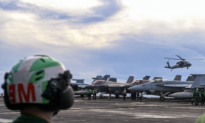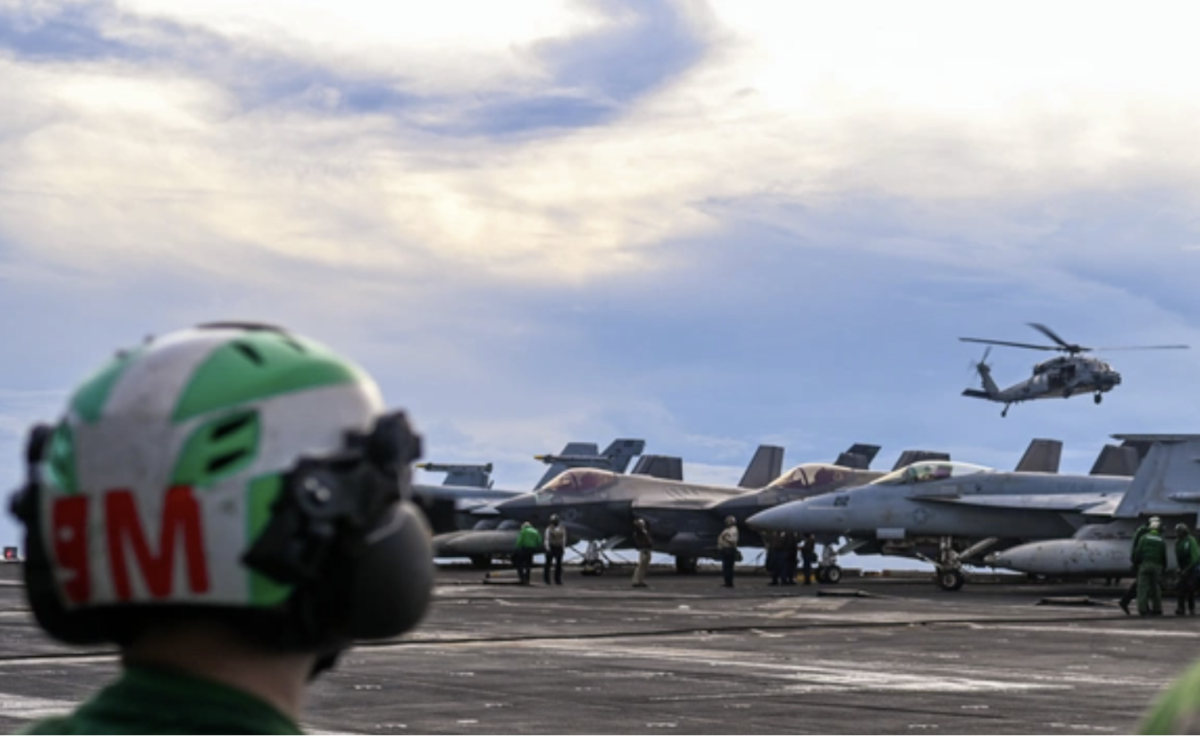

The aircraft carrier USS Theodore Roosevelt has entered the waters of the Middle East, making it the third U.S. aircraft carrier currently operating in the region.
The U.S. Central Command confirmed the Roosevelt’s arrival in the Middle East on Nov. 16. It joins the George H.W. Bush and George Washington Carrier Strike Groups, which have both been operating in the region for months, amid an ongoing armed standoff with Iran.
Five U.S. aircraft carriers have cycled through the Central Command area of responsibility since the fighting with Iran began on Feb. 28. Two other aircraft carriers that participated in the operations early on have since returned from their deployments.
The Roosevelt supports an air wing consisting of multiple squadrons of fighter jets, helicopters, and other support aircraft, providing U.S. commanders with additional resources as the standoff continues.
U.S. and Israeli forces initially struck Iran on Feb. 28, setting off 38 days of high-intensity fighting. Washington and Tehran entered into a ceasefire on April 8, but U.S. and Iranian forces have clashed intermittently in the months since, as U.S. forces have worked to enforce a blockade on Iran’s maritime trade while simultaneously escorting commercial shipping through the Strait of Hormuz.
The Roosevelt departed San Diego on Sept. 27, followed a day later by the USS Makin Island Amphibious Ready Group and its embarked 13th Marine Expeditionary Unit. The Makin Island Amphibious Ready Group is currently operating in the Pacific, though a U.S. official previously said it could join the naval force build-up in the Middle East.
The Roosevelt’s arrival in the Middle Eastern waterways comes as tensions with Iran remain high.
Last week, President Donald Trump raised hopes that the Iran conflict would end soon. Trump said renewed fighting is “quite unlikely” but signaled U.S. forces are ready for combat.
“Iran militarily is effectively over,” Trump said on Nov. 9. “We’re just keeping it the status quo, and we’re doing that really at the behest of countries that are their neighbors.”
Trump also said on Nov. 9 that talks with Iranian negotiators were ongoing. Trump has sought an agreement to constrain Tehran’s nuclear ambitions.
Mohsen Rezaei, secretary of the Islamic regime’s Supreme National Security Council, on Nov. 10, announced it would retain control over its enriched uranium rather than transferring the material abroad.
By Nov. 12, Trump announced he had pulled Vice President JD Vance off of Iran negotiations, after concluding he no longer needed a deal with the regime.
“We don’t need a deal with Iran. Those days have long since passed. We’ve got their money, Hundreds of Billions of Dollars, and we’ve got their Strait!” Trump wrote in a post on Truth Social.
On Nov. 13, Iranian forces claimed a drone attack targeting a U.S. early warning radar stationed in Bahrain. The U.S. Central Command reported its air defense forces successfully intercepted the Iranian attack drones.
Iranian forces claimed responsibility for another attack drone salvo on Nov. 15, this time targeting the Al-Riffa helicopter base. The Bahrain Defense Forces claimed its air defenders successfully blocked the attack.
Following the two recent Iranian attacks, the U.S. Embassy in Bahrain issued an updated security alert for the country, advising U.S. citizens to exercise added caution and to be mindful of a heightened risk of attacks.
In a statement carried on Iranian state media on Monday, the Iranian navy announced multiple tankers struck sea mines and caught fire while attempting to transit the Strait of Hormuz “after violating regulations.” The UK’s Maritime Trade Operations center, an office managed by the UK’s navy, reported two separate attacks in the waterway on Monday.
 Friends Read Free
Copy
Facebook
Tweet